
Holiday side business · updated
How to start a Christmas light installation business
Hanging holiday lights is a short, busy season that rewards good planning and safe ladder work. Many lawn-care, landscaping and pressure-washing businesses add it to fill their slow months. This guide covers what customers pay, what it costs to start, the safety and insurance basics, a season calendar and 30 name ideas. Every figure links to its source.
When the season runs
- Displays: usually from Thanksgiving through the first week of January. Installs start soon after Halloween (TRUiC, June 2026).
- Commercial work starts earlier. One company profiled by the National Association of Landscape Professionals starts commercial installs the last week of September, aims to finish by December 12, and starts takedown the day after New Year’s (NALP).
- Customers book early. Brite Nites, a long-running installer, asks customers to reserve by October 31 (Brite Nites). If you’re starting this year, your selling window is now.
What customers pay
| Source | What it says | Updated |
|---|---|---|
| Angi | National average $444; most homeowners pay $220–$684; $2–$5 per linear foot. One-story home $200–$450, two-story $350–$800, three-story $700–$1,500. | Oct 8, 2026 |
| HomeGuide | $5–$12 per linear foot with the installer’s lights; roofline package $250–$1,500; removal $100–$400 if it isn’t included. | Oct 2025 |
| Thumbtack | $1.25–$3 per foot to hang the customer’s own lights; installer-supplied lights add $0.50–$2 per foot; removal is about half the install price. | Not dated |
| Forbes Home | Average about $420; two-story homes $400–$1,200. | Feb 2025 |
Prices vary widely by region, home size and whether lights are included. Many installers set a minimum job; one installer interviewed by Jobber uses a $495 minimum.
What it costs to start
| Item | Typical cost | Source |
|---|---|---|
| Commercial-grade lights | $2,000–$5,000 | ZenBusiness, Jan 2026 |
| Ladders and harnesses | $300–$700 | ZenBusiness |
| Clips and accessories | $100–$200 | ZenBusiness |
| General liability insurance | $500–$1,000 a year (ZenBusiness); small businesses on Insureon average $45 a month | Insureon, Mar 2026 |
| Storage | $100–$200 a month | ZenBusiness |
| Everything except a truck | $1,940–$2,715 or more | Jobber |
For a sense of supply prices: a 1,000-foot spool of C9 light wire costs $279–$516 at 1000Bulbs (checked October 10, 2026). The difference between SPT-1 and SPT-2 wire is the insulation: SPT-2 is thicker and suits displays left up more than 90 days or very cold places (1000Bulbs).
Lease the lights or sell them?
Jobber describes two ways to run it (Jobber):
- Lease: you own reusable lights and charge a rental fee that pays them back over a few seasons, plus labor. You take them down, store them and repair them.
- Sell: the customer buys the lights, usually at a 20–50% markup, and owns them after the season.
Many companies include takedown and storage in the price. Whichever you choose, write it into a simple contract: what’s included, the takedown date, and what happens if a strand fails.
Rules and safety
- Register the business: an LLC or a registered business name (DBA), an EIN if you hire, and any local license (FindLaw). Spark’s guide to checking if a name is taken helps with the name step.
- Electrical work is different. Hanging plug-in decorations is decorating. FindLaw notes you need an electrician’s license if a customer wants electrical work done, such as new outlets or wiring. Rules vary, so check your state and city.
- Read your insurance height limit. Some installer policies exclude work above two stories (Insurance Canopy).
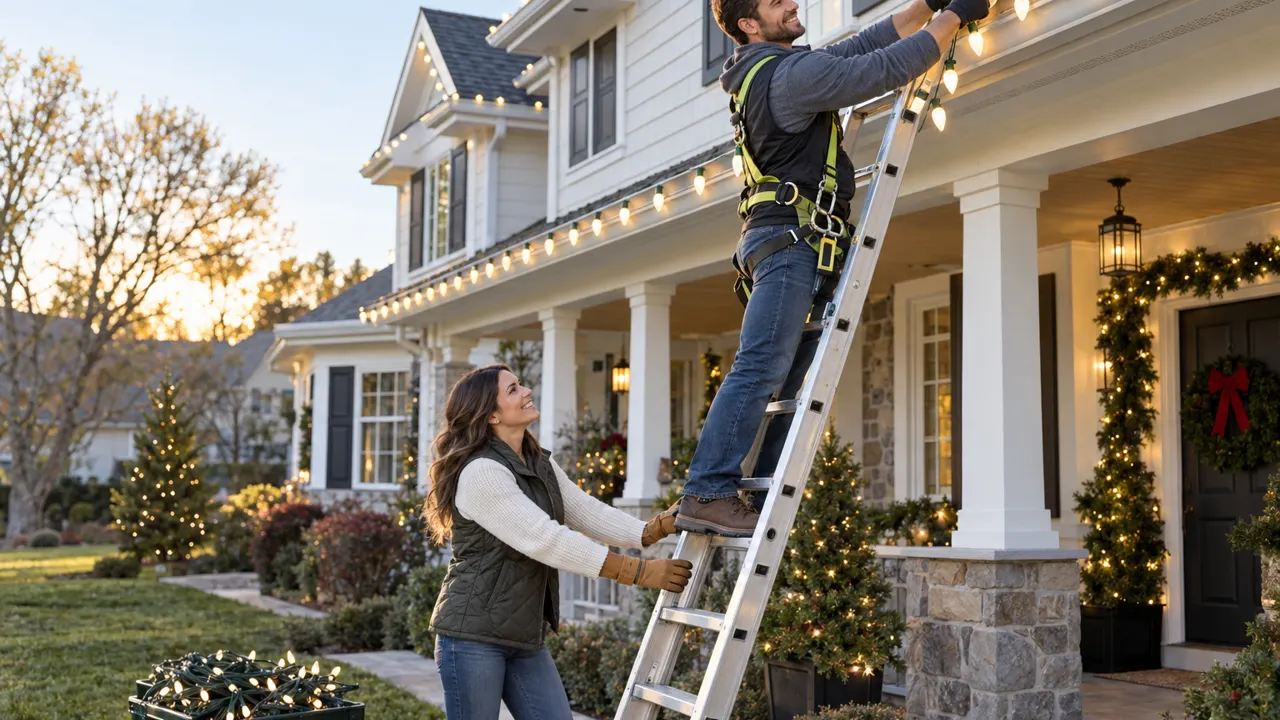
- Ladders: OSHA’s ladder card says keep three points of contact, extend the ladder 3 feet above the landing, set the base 1 foot out for every 4 feet of height, and never stand on the top three rungs (OSHA). Falls are the leading cause of death in construction, and OSHA recommends a personal fall-arrest system for roof work (OSHA).
- HOAs can set when displays go up and come down, require approval first, and ban nails or staples in roofs and siding (Florida law firm article, 2024). Use clips, and ask the homeowner about HOA rules before you quote.
- Permits: large commercial installs or displays on public property may need one (Angi).
A season calendar
1. September and October: get ready and book
Buy lights early (buying late usually costs more, and Jobber advises keeping a cash cushion). Get insured, set your prices and minimum, and start marketing by late October.
2. November: install
Lights can go up before they’re lit. Set timers so they turn on when the customer wants (TRUiC).
3. December: service calls
Keep time free for fixes. Installers in the NALP article trace many calls to customers plugging in their own lights or changing timers, so explain the setup at handover.
4. January: take down and store
Label each customer’s lights by house, store them dry, and ask about next year while the customer is happy.
Who you compete with
National franchises sell holiday lighting too, including Christmas Decor, Wonderly Lights and Outdoor Lighting Perspectives, and Home Depot refers customers to local installers. An independent competes with a name neighbors remember, quick replies and photos of real local jobs.
Finding your first customers
- Google Business Profile: businesses that visit customers can list a service area and hide their home address (Google).
- Nextdoor: a free business page collects neighbors’ recommendations (Nextdoor).
- Every job markets the next one: a yard sign while you install, before-and-after photos, and a referral thank-you (Jobber).
- Customers you already have: if you mow, wash or paint, they already trust you.
- Free Spark tools: the “now open” post maker, the business card maker and the Google review QR code.
Five mistakes to avoid
1. Hanging the customer’s old lights
Jobber warns against it: they fail more often and you get the service call.
2. Buying cheap lights
They break and cost you more in labor (TRUiC).
3. Booking more homes than you can finish
The install window is short. Plan your crew before you say yes (TRUiC).
4. Buying late with no cash cushion
Supplies cost more late in the season (Jobber).
5. No contract, weather plan or safety training
Write down what’s included and what happens on bad-weather days (FieldPromax).
30 name ideas, with the .com checked
Spark checked every .com below on October 10, 2026. A free .com today can be registered by someone else tomorrow, and a free .com doesn’t mean a name is free to use: also check your state’s business records and the USPTO’s free trademark search.
Bright and clear
TrueGlow Installs .com free · Bright Eaves .com free · Starcrest Lighting .com free · Frostline Lights .com free · Lumen and Line .com free · Brightline Holiday Lighting .com taken · Roofline Glow .com taken · Evenglow Lighting .com taken
Warm and festive
Hollyline Lights .com free · Merry Roofline .com free · Silver Bell Lighting .com free · Jolly Roofline .com free · Kindle and Crest .com free · Twinkle and Timber .com taken · Hearth and Halo .com taken · Evergreen Glow Co. .com taken
Commercial and HOA work
Beacon Holiday Lighting .com free · Landmark Holiday Lights .com free · Northstar Display Co. .com free · Clearwire Holiday .com free · Peak Season Lighting .com taken · Summit Holiday Lighting .com taken
Year-round (if you add permanent or landscape lighting)
Allseason Glow .com free · Yearlight Exterior .com free · Gutterline Glow .com free · Eaveline Lighting .com taken · Glowpath Lighting .com taken
Fun and memorable
Lit Up Right .com free · Sleigh the Roof .com free · Elf Help Lighting .com free · Ho Ho Hang .com taken
Three naming tips for this trade. Leave “Christmas” out if you may sell permanent lighting or landscape lights later. Leave your town out so you can grow. And keep it to two or three words that read from the street on a yard sign and a truck door.
Questions people ask
How much do Christmas light installers charge?
Angi puts the national average at $444, with most homeowners paying between $220 and $684, or $2 to $5 per linear foot (updated October 8, 2026). HomeGuide lists $5 to $12 per linear foot when the installer supplies the lights. Prices vary a lot by region and by how big the home is.
Do I need a license to hang Christmas lights?
You need the normal business basics: an LLC or a registered business name (DBA), an EIN if you hire, and any license your state, county or city requires. FindLaw notes you need an electrician's license if a customer wants electrical work done, such as new outlets or wiring. Check your local rules.
How much does it cost to start a Christmas light business?
Jobber estimates $1,940 to $2,715 or more without a truck. ZenBusiness lists $2,000 to $5,000 for commercial-grade lights alone and $5,000 to $30,000 for the whole setup including a vehicle.
When should I start booking customers?
Early. Installs usually start soon after Halloween, and some companies ask customers to reserve by October 31. Marketing in late October is common.
Should I hang the customer's own lights?
Many professionals won't. Jobber warns against installing client-owned lights because they fail more often and the installer gets the service call. Using your own commercial-grade lights also lets you lease them year after year.
Not legal, tax or insurance advice. This page summarises the sources linked above as of October 10, 2026. Prices and rules change; confirm with your state, city and insurer.
Keep going
holiday side hustles 2026 · landscaping names · pressure washing names · lawn care names · handyman names · free name check
Want a name that already passes these checks?
Tell Spark your idea in one sentence. Get 6 brands, each with a name, a live .com check, a first trademark screen when one is available, a logo, colors and a brand photo.
Founding price $39 one time for the first 100 customers · Regular price $49 · one payment, no subscription
Build my brand — $39One payment · No subscription · Secure checkout